
Which Programming Language to Choose for Data Science in 2025?
Introduction
Data science is one of the fastest-growing careers, but a common question for beginners is Which programming language should I learn for data science? With Python, R, SQL, Julia, and others in the mix, the answer depends on your career goals. In this blog, we’ll compare the best languages for data science in 2025 and help you make the right choice.
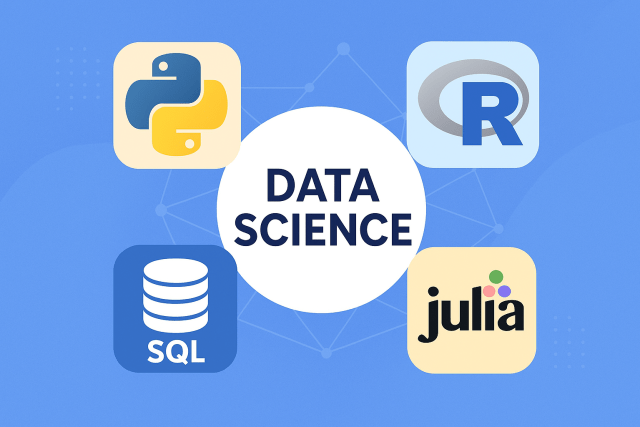
Python: The Most Popular Language for Data Science
Python dominates the data science world.
Why Python?
- Beginner-friendly and versatile.
- Huge ecosystem: NumPy, pandas, scikit-learn, TensorFlow, PyTorch, Matplotlib, Seaborn.
- Excellent for machine learning, AI, and automation.
Python best For: Beginners, ML engineers, AI specialists.
R: The Best Language for Statistics and Visualization
R is the go-to choice for statisticians and academic researchers.
Why R?
- Advanced statistical modeling and visualization.
- Libraries like ggplot2, dplyr, caret, Shiny.
- Strong adoption in healthcare, academia, and finance.
R best For: Statisticians, researchers, data analysts.
SQL: The Must-Have Skill
No matter which language you choose, SQL is non-negotiable.
Why SQL?
- Essential for extracting and cleaning data.
- Used in ETL processes.
- Required in almost all job descriptions.
SQL best For: Every data science professional.
Julia: High-Performance Language for Data Science
Julia is gaining traction for speed and efficiency.
Why Julia?
- Combines C-like performance with Python-like simplicity.
- Excellent for scientific computing, optimization, and large ML datasets.
- Still a small ecosystem compared to Python.
Julia best For: Researchers, large-scale ML projects.
Other Languages Worth Knowing
- Scala/Java Perfect for big data with Apache Spark.
- MATLAB Strong in engineering & simulations.
C++ Powers ML libraries but rarely used directly.
Comparison Table: Best Programming Languages for Data Science
| Language | Strengths | Weaknesses | Best For | Popular Libraries |
| Python | Easy to learn, versatile, huge ecosystem | Slower than C/Java | Beginners, ML, AI | NumPy, pandas, scikit-learn, TensorFlow |
| R | Statistics, visualization, research-friendly | Less general-purpose | Statisticians, researchers | ggplot2, dplyr, Shiny |
| SQL | Essential for data handling | Not for ML | Everyone in DS | N/A |
| Julia | Very fast, numerical computing | Limited ecosystem | Researchers, ML-heavy work | Flux.jl, JuMP |
| Scala/Java | Great for big data frameworks | Steeper learning curve | Big data engineers | Spark |
| MATLAB | Engineering, simulations | Paid, niche use | Academia, research | Built-in toolboxes |
My Opinion
- Start with Python + SQL the winning combo for most careers.
- Add R if you’re research/statistics-heavy.
Explore Julia or Scala only for specialized or high-performance needs.
FAQs
Is Python better than R for data science?
Python is better for general-purpose data science, ML, and AI, while R is stronger in statistics and visualization. Beginners usually start with Python.
Do I need SQL for data science?
Yes, SQL is essential for handling databases. Almost all companies require SQL alongside Python or R.
Is Julia replacing Python in data science?
Not yet. Julia is fast and excellent for scientific computing, but Python’s ecosystem makes it the dominant choice.
Which language should beginners learn first?
Start with Python, and pair it with SQL for databases.
Can I learn both Python and R?
Yes, many professionals use both: Python for ML/AI, R for analytics and visualization.
Tags:
best programming language for data sciencedata science beginner guideJulia for machine learningprogramming languages for data science 2025Python for machine learningPython vs R data scienceR for statistics and visualizationSQL for data analyticsSQL for data sciencewhich language to learn for data sciencePython | ML | AI | Data Analytics
Let’s get started
LearnSkill - invest in yourself
